Compound vs. streak-based habit trackers
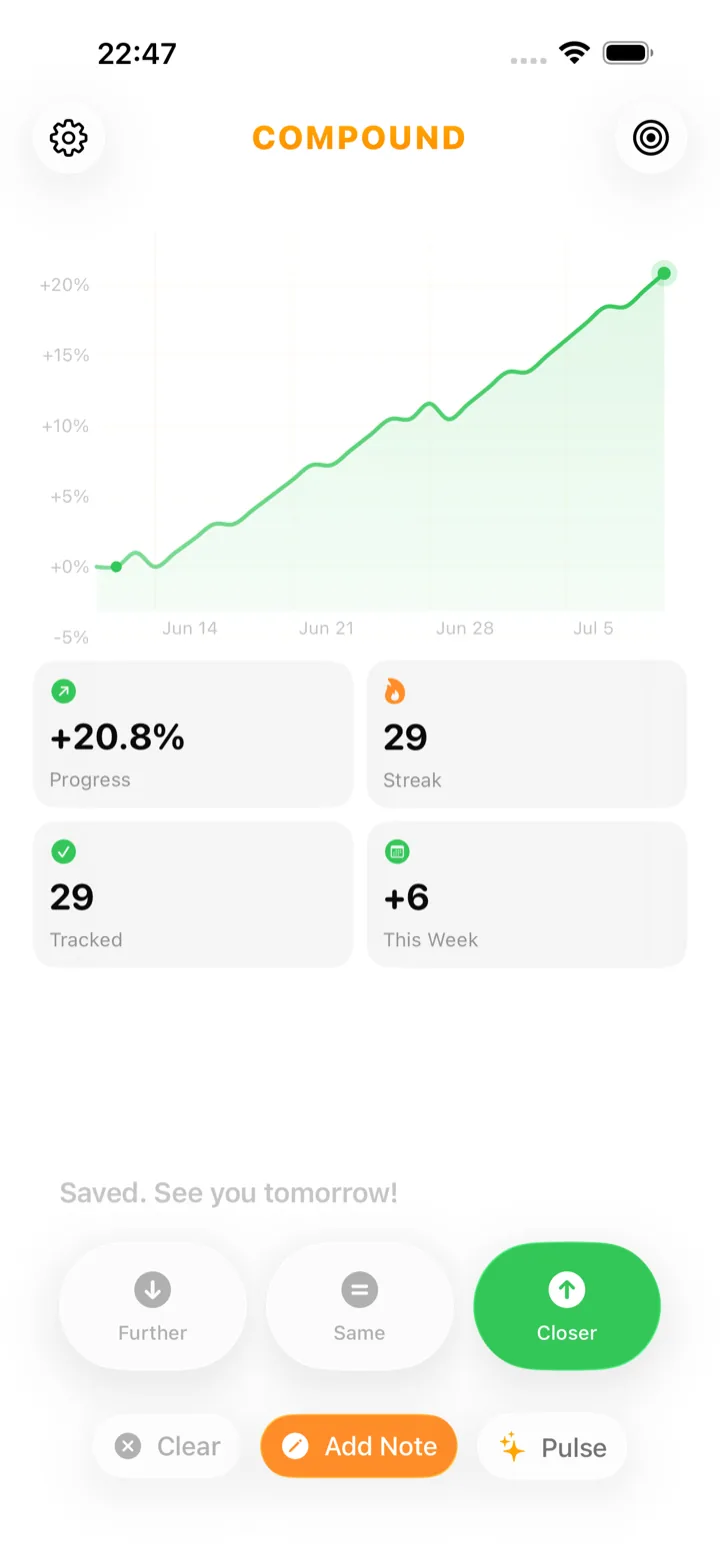
Streaks, Habitica, and Loop Habit Tracker are built around completing individual habits and keeping a chain alive. Compound asks one broader question — did today move you closer to your goal? — and charts the answers as a trajectory, so a missed day is a gap in the record, not a reset of your progress.

Two models of progress
Streak apps track completion: did you do each habit today? Compound tracks direction: did your day move you toward the goal? Both rely on self-report — the difference is what a bad day does to the picture.
A checklist model shines when the behavior is binary and repeatable: floss, take the pill, write for ten minutes. Each habit gets its own box, and the app’s job is to make sure no box goes unticked. The cost is that the model has no vocabulary for a hard day — a day where you did less than planned but more than nothing is scored exactly like a day you gave up.
Compound compresses the whole day into one honest judgment: ↑ Closer, → Same, or ↓ Further. That loses per-habit detail — deliberately — and gains something checklists can’t express: a bad day is a valid, recorded answer rather than a broken chain. Over weeks, the answers draw a trajectory that shows whether life is actually bending toward the goal.
What Streaks, Habitica, and Loop each do well
All three are good apps with real strengths — the comparison is about which model of motivation fits you, not which app is objectively best.
Streaks (iOS)
A polished Apple-ecosystem habit checklist built around consecutive-day chains, with deep HealthKit and widget integration. Great when your habits are binary, you want tight iOS integration, and an unbroken chain motivates rather than stresses you.
Habitica
A free, open-source habit RPG: your real-life habits feed a pixel avatar, missed dailies cost it health, and you can join parties and quests with friends. Great if game mechanics and social accountability genuinely pull you back day after day.
Loop Habit Tracker (Android)
A free, open-source tracker whose habit-strength score decays gradually on missed days instead of resetting to zero — the gentlest scoring of the three. Great for detailed per-habit history and charts on Android, with no subscription at all.
Side by side
The structural difference in one table: what each model asks of you daily, and what it does with an imperfect day.
| Dimension | Compound | Streak-based apps |
|---|---|---|
| Daily effort | One tap, 3–5 seconds | Log tasks, check boxes, maintain lists |
| What’s tracked | Direction toward your goal | Completion of individual habits |
| A missed day | Shows as an honest gap — nothing resets | Breaks the chain, prompts guilt |
| A bad day | ↓ Further is a valid, recorded answer | Doesn’t fit the model |
| Engagement | One quiet daily question | Reminders, badges, pressure loops |
| Price | Free; Pulse reflections in Compound Pro | Varies |
When a streak tracker is the better choice
Choose a streak-based tracker when your habits are binary and mechanical, chains motivate you, you want per-habit data, or you’re on Android — Compound is iPhone and iPad only.
Be honest about your own psychology. If a 90-day chain fills you with pride rather than dread, streaks are a feature, not a bug — some people run multi-year chains and love every day of them. Streak apps are also the right tool when you need per-habit granularity: which specific habits stuck, which slipped, at what time of day.
There are practical reasons too. Compound requires iOS 26 or later, so Android users are better served by Loop Habit Tracker or Habitica. And if your goal really is a set of small mechanical behaviors rather than one larger direction, a checklist maps onto it more naturally.
When Compound fits better
Choose Compound when the goal is bigger than a checkbox, when a slip must not erase visible progress, or when every previous tracker died of guilt or setup effort.
Goals like saving money, job hunting, or quitting smoking aren’t lists of identical daily tasks — they’re a direction sustained across messy, varied days. One honest answer a day fits that shape better than a dozen boxes designed for flossing.
The difference matters most in relapse-prone changes. Research on the abstinence violation effect shows that interpreting one slip as total failure is what turns a lapse into a full relapse — and a counter resetting to zero is that interpretation, built into the interface. In Compound a slip is a ↓ dip in the chart, surrounded by the weeks of progress it did not erase.
And if you’ve abandoned three habit apps because setup was heavy or a broken streak made you close the app for good, the 3-second daily cost and streak-free model are the point: the tracker survives your worst weeks, which is exactly when you need it.
Comparison questions
Related ways to use Compound
Curious about the research behind this? Why streaks fail →
Compound is a general goal & habit tracker — see everything it does →
See you tomorrow.
 Scan to download on your iPhone