Why streaks fail
A streak compresses weeks of effort into a single number that one missed day resets to zero. Behavioral research suggests this punishes exactly the moment that decides long-term success — the day after a slip — even though missing a single day has no measurable effect on habit formation.

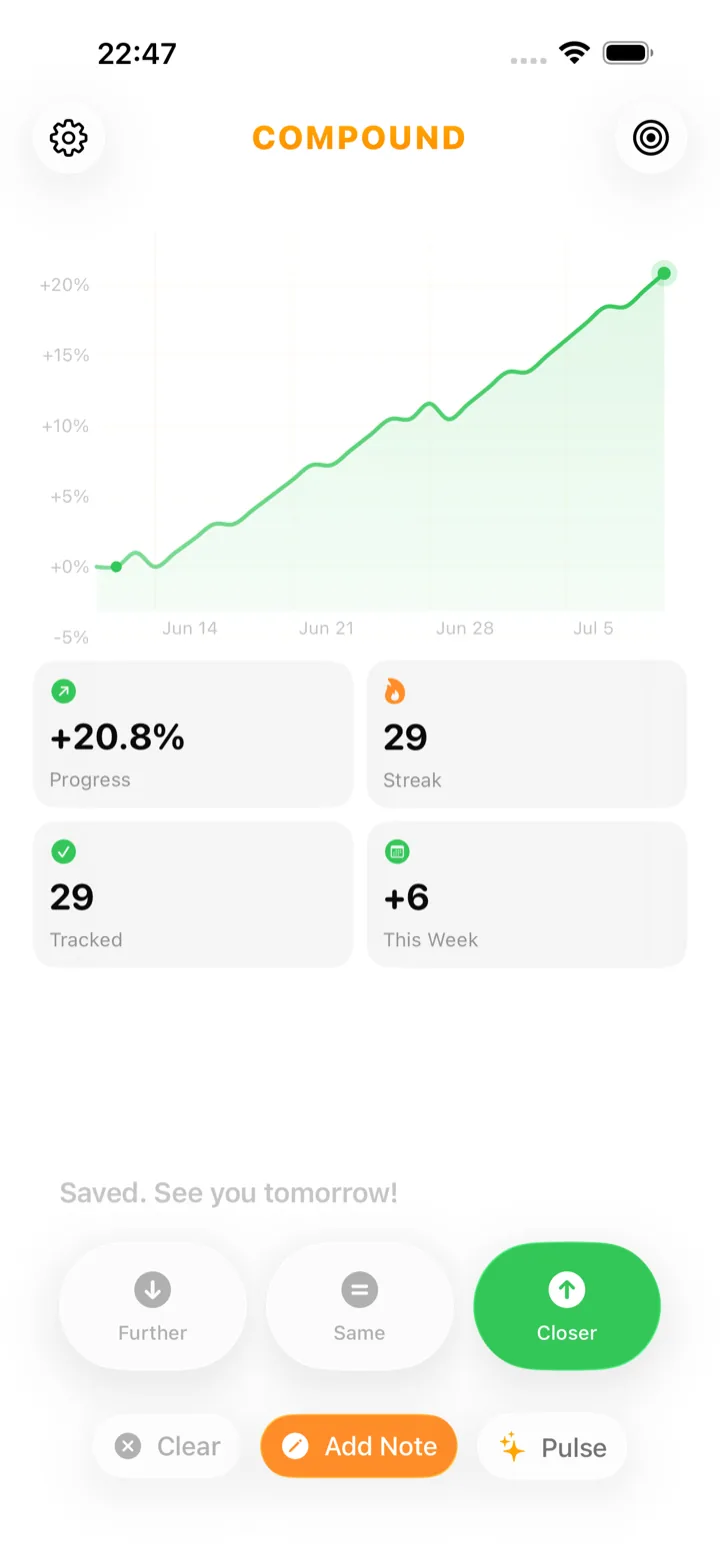

Missing one day doesn’t stop a habit
In the largest real-world study of habit formation, missing one day made no measurable difference to whether the habit eventually formed — the streak model punishes something the evidence says doesn’t matter.
Phillippa Lally and colleagues at University College London followed 96 people building a new daily habit and measured how automatic the behavior became over 12 weeks. Habits took 66 days on average to form (ranging from 18 to over 250), and in the authors’ words, “missing one opportunity to perform the behaviour did not materially affect the habit formation process” (Lally et al., European Journal of Social Psychology, 2010).
A streak counter encodes the opposite belief: that one miss destroys everything the previous sixty days built. When the interface and the evidence disagree, it’s the interface that generates the guilt.
The what-the-hell effect
Once a rule is visibly broken, people tend to abandon the goal entirely for the rest of the day or week — “I’ve blown it anyway.” A broken streak manufactures that moment on screen.
The effect was first documented in dieting research by Janet Polivy and C. Peter Herman: dieters who believed they had already broken their diet went on to eat more than people who weren’t dieting at all. The rule violation itself — not hunger — triggered the collapse.
A streak works the same way. The number on screen was the reward; when it reads zero, the visible incentive to act today is gone. People rarely quit on the day they miss — they quit on the day after, when the app tells them they’re starting over.
The abstinence violation effect
In relapse research, what predicts a full relapse is not the lapse itself but interpreting it as personal failure. A counter that resets to zero hard-codes that interpretation.
G. Alan Marlatt’s relapse-prevention work found that people who read a single lapse as proof of weak character (“I have no willpower”) were far more likely to relapse fully than people who read it as a one-off event with situational causes. The interpretation, not the slip, decides what happens next.
Day counters used for quitting smoking, drinking, or vaping are the harshest version of this: 47 days sober becomes 0 the morning after one drink, visually erasing everything the person actually achieved. In Compound the same night is one ↓ answer — a dip in a chart that still shows six weeks of progress around it.
Tracking still works — when the record survives a bad day
Monitoring progress reliably improves goal attainment; the fix is not to stop tracking but to use a record where a bad day is data instead of deletion.
A meta-analysis of 138 experiments found that prompting people to monitor their progress reliably increased goal attainment (Harkin et al., Psychological Bulletin, 2016). Self-monitoring is one of the best-supported tools in behavior change — a streak is just one scoring rule layered on top of it, and the rule is the problem.
Compound keeps the monitoring and drops the rule: one question a day, three honest answers, a trajectory chart that absorbs dips and gaps. Miss a day and it stays a visible gap; slip and ↓ Further is recorded like any other data point. The record survives your worst week — which is when a record is worth having.
Questions about streaks
Related ways to use Compound
See how Compound compares to Streaks, Habitica, and Loop →
Compound is a general goal & habit tracker — see everything it does →
See you tomorrow.
 Scan to download on your iPhone